
Parents searching for educational learning games face a common dilemma. Apps promise engagement but deliver passive screen time. Board games teach concepts but lack physical exploration. Worksheets reinforce skills but feel like homework disguised as play.
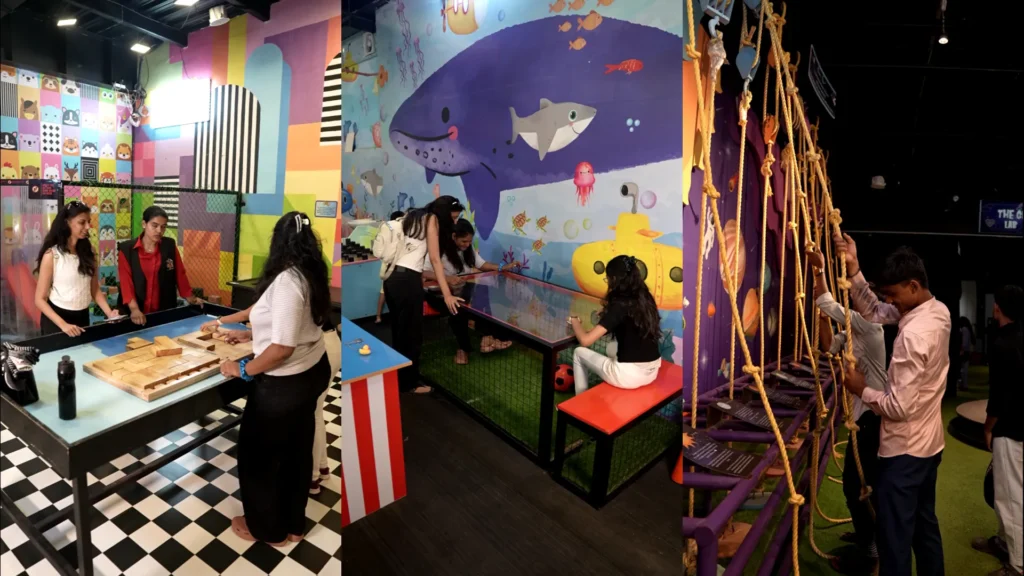
MAD Labs addresses this gap through hands-on learning games that combine education with active exploration. Located inside Snow City on Jayamahal Main Road, MAD Labs creates environments where kids learn through experimentation, not instruction. Water flow, light physics, balance challenges, and pattern recognition become games that teach without feeling educational.
For Bangalore families seeking educational learning games that prioritize movement, curiosity, and problem-solving over screens and lectures, MAD Labs offers a screen-free alternative where learning happens through play. This article explains why hands-on educational activities deliver stronger developmental outcomes than digital alternatives – and how MAD Labs makes this accessible for families.
Why Hands-On Learning Games Beat Screen-Based Apps
Educational apps have flooded the market, each claiming to boost learning through gamified lessons. While digital educational games for kids offer convenience, research shows they deliver weaker retention compared to physical engagement.
Hands-on learning games activate multi-sensory processing. Kids who manipulate physical objects, observe cause and effect, and adjust strategies based on real-world feedback develop deeper conceptual understanding. Screens offer visual and auditory input but lack the tactile and spatial components that strengthen neural pathways.
At MAD Labs, educational learning games engage touch, movement, and visual processing simultaneously. Thermal Paint Wall teaches thermochromism through hands-on color changes. Hydro Lab demonstrates fluid dynamics through direct water manipulation. These interactive learning games create memory anchors that persist longer than app-based lessons.
The difference isn’t just educational – it’s developmental. Screen-free learning games support motor skill development, spatial reasoning, and social interaction in ways digital platforms can’t replicate.
Learning Activities for Kids That Feel Like Play
The best educational learning games teach without announcing themselves as lessons. Kids engage because activities feel interesting, not because they’re labeled educational.
MAD Labs zones operate on this principle. Space Lab introduces gravity and motion through interactive challenges where kids test how objects behave under different conditions. Magno Lab builds pattern recognition and spatial thinking through magnetic construction. Wobble Lab teaches balance and weight distribution through hands-on experimentation.
These STEM learning activities for kids work because exploration happens naturally. Kids aren’t following instructions – they’re discovering rules through trial and error. Jump Challenge demonstrates energy transfer and momentum. Shadow Talkies reveals how light source position affects shadow behavior.
Parents searching for hands-on educational games Bangalore often want activities that combine fun with learning. MAD Labs delivers this by embedding educational concepts into zones where kids control outcomes, making every experiment a lesson in cause and effect.
How Interactive Learning Games Support Cognitive Development
Educational learning games that prioritize interaction over instruction develop critical thinking differently than passive content consumption. When kids face challenges where multiple solutions exist, they practice hypothesis formation, testing, and revision.
MAD Labs zones create these open-ended problem spaces. Hand Stabilizer Game challenges coordination and patience. Parachute Challenge requires group strategy and timing. Bubble Zone explores surface tension through experimentation with different bubble sizes and techniques.
These interactive learning activities Bangalore parents seek support executive function development – planning, focus, and adaptability. Unlike apps that provide answers when kids struggle, hands-on zones require persistence and creative thinking to succeed.
Research shows that children who engage regularly with hands-on learning games demonstrate stronger problem-solving abilities and longer attention spans compared to peers who primarily use digital educational tools.
Social Learning: Why Group Educational Activities Matter
One major limitation of educational games for kids delivered through apps is isolation. Even multiplayer digital games lack the face-to-face communication, negotiation, and cooperation that physical group activities require.
MAD Labs encourages collaborative learning naturally. Parachute Challenge requires coordination between multiple kids. Bubble Zone becomes more interesting when kids compare techniques. Jump Challenge turns into friendly competition that builds motivation.
These social dimensions make MAD Labs valuable for educational indoor activities Bangalore families choose during weekends or holidays. Kids don’t just learn concepts – they learn communication, turn-taking, and shared problem-solving.
Parents notice this difference. After visits to educational learning games venues like MAD Labs, kids talk about what they discovered with friends, reinforcing concepts through social memory rather than isolated recall.
Age-Appropriate Educational Learning Games for Different Stages
Effective educational learning games scale across developmental stages. What engages a 5-year-old differs from what challenges a 12-year-old. The best venues offer zones that accommodate this range without requiring age segregation.
MAD Labs addresses this through multi-level zone design. Kiddies Lab provides safe sensory exploration for younger kids (ages 3–6). Thermal Paint Wall and Bubble Zone engage elementary-age children (7–10). Hand Stabilizer Game and Space Lab challenge tweens and teens (11–14) with coordination and strategic thinking.
This flexibility makes MAD Labs practical for families with kids at different developmental stages. Parents don’t need separate educational activities for children – zones adapt to how each age group engages them.
When evaluating learning games Bangalore venues, parents should prioritize spaces where younger siblings and older kids find equally engaging activities. MAD Labs delivers this through zone variety rather than age-specific programming.
The Screen-Free Advantage: Why Physical Play Still Matters
Screen time has become a growing concern for Bangalore parents. Educational apps offer convenience but contribute to sedentary behavior, eye strain, and reduced physical activity.
Hands-on educational games Bangalore parents seek through MAD Labs provide screen-free alternatives that support physical development alongside cognitive growth. Jump Challenge builds gross motor skills. Hand Stabilizer Game develops fine motor control. Movement-based zones combat the sedentary patterns digital games reinforce.
Parents report that kids who regularly engage with screen-free learning games demonstrate better focus, longer attention spans, and stronger physical coordination compared to peers who primarily use digital educational tools.
MAD Labs offers a practical solution for families wanting to reduce screen dependency without sacrificing educational engagement. Interactive zones deliver the curiosity and challenge apps promise – but through physical exploration rather than pixels.
FAQs: Educational Learning Games at MAD Labs
- What age groups benefit most from MAD Labs educational learning games?
MAD Labs zones engage ages 3–14 primarily, with activities that scale from sensory exploration for younger kids to strategic challenges for tweens. Older siblings and adults find value in zones like Hand Stabilizer Game and Space Lab.
- Are MAD Labs activities aligned with school curriculum?
Yes. MAD Labs STEM learning activities for kids connect to physics, biology, and critical thinking concepts taught in CBSE, ICSE, and IGCSE curricula. Zones reinforce classroom learning through hands-on exploration.
- How long should families plan for a MAD Labs visit?
Most families spend 2–3 hours at MAD Labs, allowing kids to explore 8–12 zones without feeling rushed. Some families extend visits by combining MAD Labs with Snow City for a full-day outing.
- What makes MAD Labs different from other educational activities for children Bangalore?
MAD Labs focuses on exploration-based learning rather than instruction. Instead of guided lessons, kids discover concepts through trial, error, and observation. This hands-on approach creates stronger retention than passive learning formats.
- Can parents stay with kids during MAD Labs visits?
Yes. Parents accompany kids throughout MAD Labs. Many parents engage with zones alongside children, making it a family learning experience rather than a drop-off activity.
- How does MAD Labs compare to digital educational games for kids?
MAD Labs offers hands-on learning games that engage multiple senses and support physical development alongside cognitive growth. Unlike apps, MAD Labs zones require movement, coordination, and social interaction – creating stronger developmental outcomes than screen-based alternatives.
Experience Educational Learning Games at MAD Labs
When choosing educational learning games for kids, parents face trade-offs between convenience and developmental impact. Digital apps offer easy access but limited physical engagement. Traditional board games teach concepts but lack experiential depth.
MAD Labs solves this through hands-on learning games that combine STEM education, screen-free exploration, and active play. Interactive zones turn abstract concepts into tangible experiences, creating retention that outlasts app-based lessons.
For Bangalore families seeking educational activities for children that prioritize curiosity, problem-solving, and movement over screens and lectures, MAD Labs offers a practical alternative where learning happens through exploration, not instruction.
Visit MAD Labs today:
📍 1st Floor, Snow City, Jayamahal Main Rd, Opp. TV Tower, J.C. Nagar, Bengaluru – 560006
📞 +91 70226 67669🎟 Book Now: https://themadlabs.in/ticket-booking/